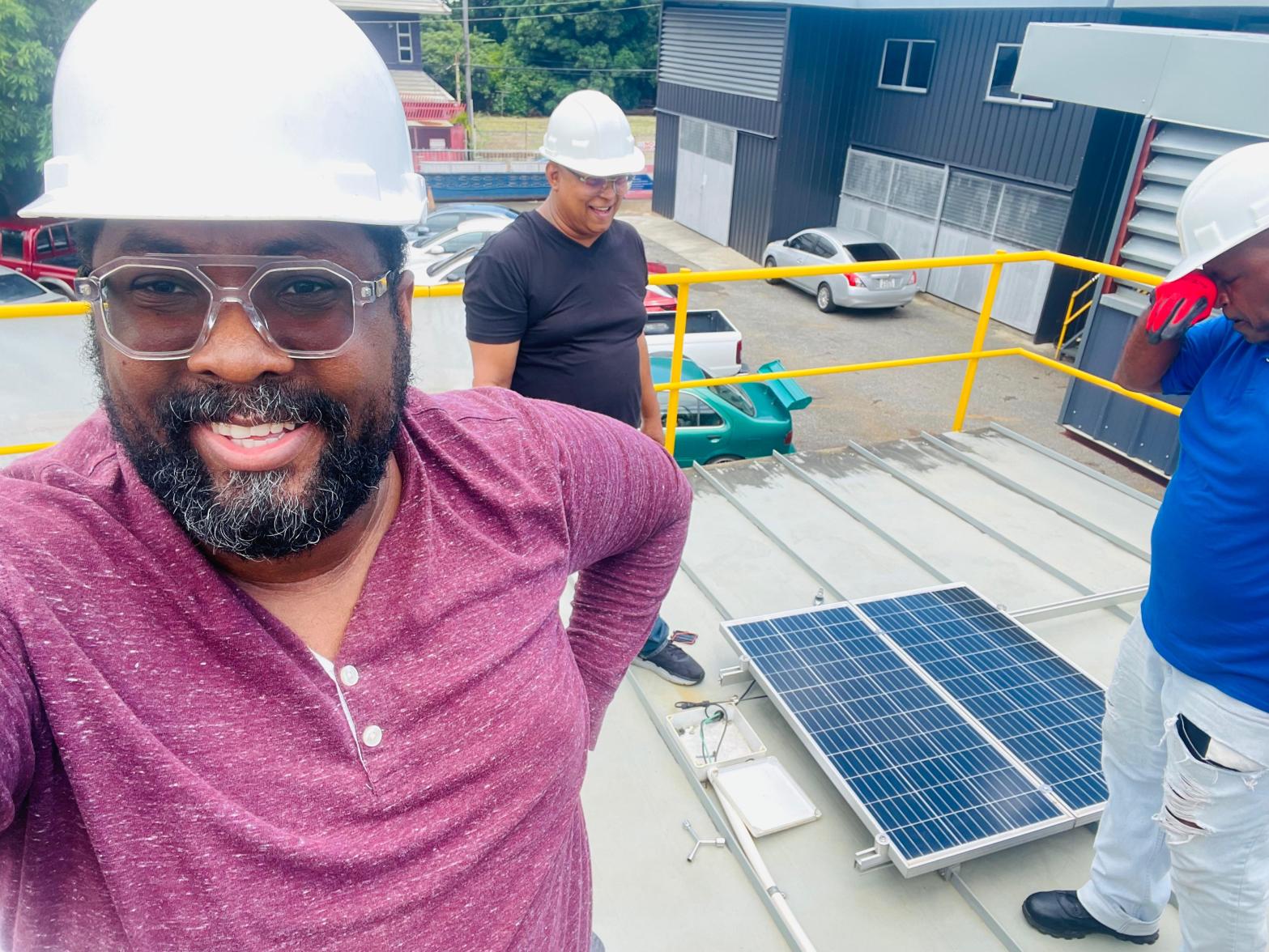
As you know, for more than the last 6 months I have been enamored with electric vehicles as my next mobility choice. This has led me into another rabbit-hole of comparable expense; photovoltaic (solar) systems (PV systems). Although in recent months my interest in solar has grown, it has not been the first time PV systems has piqued my interest. About a year ago I saw a post on Facebook from a local service provider publicizing their solar packages. The lowest cost package is starting at $105,000 TT going up past $200,000 TT. Depending on the number of solar panels and battery capacity the price can exotically balloon. Given those costs I quickly lost interest in the topic. At least, until now.
I have been on break from my bachelor’s studies and found myself with idle time for the second half of 2025 into January next year and craving stimulation. Nothing that is demanding as a college program, but something that will keep my mind occupied. That is when PV system installation came to mind. After some deliberation on which PV program I would attend I settled on Implementing Photovoltaic Systems for Solar Power Generation (Level 1) program at SBCS.
I am currently in the tail end of the program. The class is made up of about 10 students. It is the right class size to ensure the students can get a grasp of the material, while having appropriate access to the lecturer. The program is in person, which is important considering I would want hands on experience with the actual components, tools, and accessories comprising these solar systems. The program is 40 contact hours over a 2-month period. Which is the right pace for me.
The instructor blends theory with practical. throughout the program when a topic can benefit from quick demonstrations. Making the subject easy to grasp. Last week, I finally reached the point in the program where I was taught how to design and size a photovoltaic system. It has been the thing I was most eager to learn. But first, I had to understand solar panel technology, DC-to-AC conversion, and how the components integrate into the household electrical system.
I also learned about the components that make up a photovoltaic system including the panels, inverters, MPPTs, PV strings, ATS, BMS and batteries. I have begun applying knowledge gained to design a system for myself.
Here is how to determine the size of your photovoltaic system to cover 100% of the energy usage:
- Determine your daily energy usage by using your electric bill. My usage averaged 2,057 KWh every two months over the past 6 months.
- Daily energy usage is 2057 kW / 60 days = 34.3 kWh / day
- Determine what percentage of the electric bill to offset. I am aiming for 100% offset. Which equals 34.3 kWh.
- Calculate array size.
- Peak Sun Hours (PSH ) in Trinidad: 5.5 hours
- Efficiency loss = ~ 15% (0.15)
- Array size = (daily energy usage offset / Peak Sun Hours) x (1 – efficiency loss) = (34.3 kWh / 5.5 h) x (1- 0.15) = 5.30 KW (5300 W)
- Determine the number of panels needed (assuming 580 watts each)
- Panels = 5300 W/ 580 W= 9.14
- Rounded up to 10 panels
This 10-panel array should provide for my all the energy needs on average. Although, I must consider is energy is not being generated 24 hours a day. Even though this system will generate enough power for the entire days needs, it will only do so during peak sun hours. Outside this window, the grid will provide power.
If you prefer an off-grid setup, you’ll need battery storage. Batteries are rated in kWh—the amount of power (in kW) they can supply for one hour. So a 10 kWh battery can provide 10 kW for 1 hour, 5 kW for 2 hours, or 2 kW for 5 hours.
The more devices you power, the faster the battery drains. When sizing your battery, consider space, energy needs, runtime, grid resale plans (if any), and cost. Locally, overbuilding your system holds little advantage because:
- Billing follows a flat rate—no time-of-use pricing
- No rebates when you supply excess to the grid
- The utility doesn’t pay for surplus energy
My rule of thumb you will want about 50% of your daily energy usage plus or minus 10% in your battery system. This should allow you to power around half your home all day or your whole home for about an 8-hour period at night, when the photovoltaic system is not providing any power. This balances cost, power and duration in a manageable ratio. If you desire to be prepared for extended power loss or situations where it is cloudy or rainy and the photovoltaic systems is not providing peak power, you can go to a 100% battery to daily power usage ratio if your budget allows. For me 50% is sufficient which means I would require:
Battery storage needs = daily power usage / 2 = 34.3 / 2 = 17.15 kWh.
Considering battery systems typically come in 5 kWh increments I have to decide between 20 kWh or 15 kWh.
Now these calculations are based on an ideal custom configurated systems. It may be more economical to see what is currently being sold in the open market. Some companies have preconfigured packages that may be more applicable to the average buyer. Companies like Royal Crest Industries. They offer 4 packages that you can consider based on your budget and needs.

Special Considerations
Not all PV systems function during a power outage. Due to safety requirements for a grid-tired PV systems during power loss at the mains, depending on the design, the system either shuts down partially or completely. This is to protect service persons working on the power lines to avoid power feeding into the lines when they are being worked on.
Therefore, you must chose between two option if you want system to operate during loss of main power.
- Split system: separates load into 2 categories main and critical. During loss of main power only critical loads are powered by solar and battery system. Will consist of a main panel for high demand or non-critical devices that will lose power during a power outage e.g. dryer, water heater air conditioning. Secondary panel for critical devices e.g. refrigerator, lighting, automatic gate, internet equipment, security cameras. These stays powered by PV systems during loss of main power.
- Unified system: all loads on single panel although PV system must have enough power for peak demands and would require a more expensive PV system.
Speaking of peak demand, typical solar systems are designed to supply average daily power needs. To ensure ability to provide power for all use cases a more powerful system would be needed. For example, my daily usage for power is 34kWh at PV system design requires 5300 watts of solar power. This becomes the maximum supplied power at any one-time by the solar system. With appliances like a dryer or electric water heater there can be relative short bursts of very high demand. During usage 5,600 watt for 20 minutes for a drier one to two times a day or 11,000 watts for 10 minutes 20 times a day with a water heater is unusual. If both items are in use peak demand for the household could reach 20,000 or more watts. Therefore, if you want to ensure you never use grid power you may need to double or quadruple your solar power generation capabilities.
Main Takeaways
- You do not need a large solar array 10 panels in my example provide power for my entire home’s needs.
- You can size accurately using the provided formulas.
- Avoid overbuilding your system when it yields no benifit currently.
- Can aim for at least 50% daily usage in battery capacity
- For true self sufficiency you will need an exponentially larger solar array.
When I decide to move forward with my own system I intend to purchase a photovoltaic system including panels, wiring, connectors, batteries, inverters, and other accessories then install the system myself. To that end found a few leads on some Chinese suppliers so I can get factory direct pricing. Hopefully I can skip the middle man.
 Jemuel|Griffith