I keep circling back to one question as I contemplate EV ownership: Can I comfortably own an EV without installing a home charger? My current circumstances may not allow me to install an EV charger at my rental unit; therefore, I may be dependent on public chargers, must determine the availability of charges throughout the country. Over the last several days, I have started gathering information on location and types of chargers.
Charging time fluctuates based on battery size, the type of charger and whether the charger uses AC or DC. For easy comparison, I will use a 60 kWh (Kilowatt-hour) battery, which represents a common battery size installed on EVs currently available. For now, I will ignore charging-connectors standards as there are a few different competing ones, and you have little control over what connector standard is installed on the car or public charger. Although it can be converted easily with the right adapter.
TLDR: No fast charges publicly available. Therefore, 5-6 hours from 10% to full is a reasonable expectation. Therefore, this method is unsuitable for everyday EV use without major inconvenience.
EV Charger Types
| Feature | Level 1 | Level 2 | Level 3 |
|---|---|---|---|
| Typical Source | Standard 120v AC wall plug | Dryer plug/dedicated 230v AC circuit | Commercial 400-800V DC system |
| Included With Car | Yes | Maybe (free gift with purchase of vehicle) | No |
| Power Output | ~2.2 kW | 6-11 kW (50-60A) | 100-200 kW |
| Installation Cost | None | TTD $1,000-$2,000 | High. Commercial installation required |
| Charge Time (0-100%) | 25 – 30 hours | 5.5 – 7 hours | 30 minutes – 1 hour |
| Range Added per Hour | +16 km/hr | +70 km/hr | +500 km/hr |
| Best Use Case | Emergency use | Home/destination charging | Public fast charging stations |
| Notes | Slowest option | Ideal for at home charging | Ideal for public charging |
| Connector Type | J1772 (Type 1), Mennekes (Type 2), Tesla/North American Charging Standard | J1772 (Type 1), Mennekes (Type 2), Tesla/North American Charging Standard | CCS1, CCS2, CHAdeMO, GB/T or Tesla/North American Charging Standard |
Types of Charging Connectors
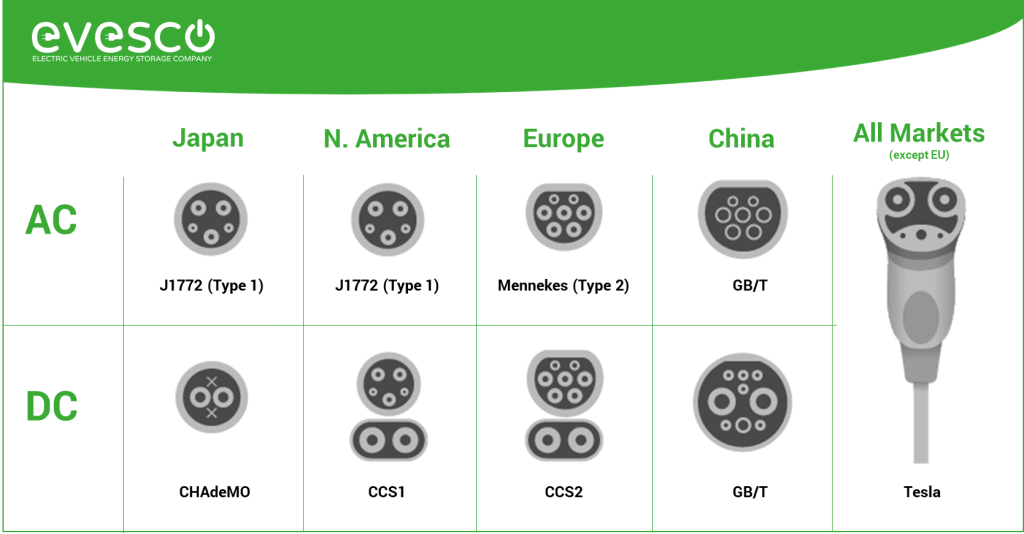
EVs being sold on the local market include the following connector types: J1772, Mennekes (Type 2), Tesla/North American Charging Standard, CCS1 or CCS2. I am not aware of any vehicles using CHAdeMO or GB/T.
Chargers Stations on the Market
As the information above shows, the vehicles include a Level 1 charger, and you can connect to power readily via a standard wall socket. However, it charges so slowly that it becomes useless as the primary charging solution. A Level 2 charger delivers faster charging, but you must consider special installation requirements at home. Although it outperforms Level 1 and works well for overnight charging, it still performs poorly for charging on the go. That is charging as I travel from one location to another while running errands. If I rely on these types chargers as my primary method of ‘refuelling’ and my battery drops to 10%, I could spend up sitting in my car up to five hours waiting for a full charge. That amount of time sitting at a gas station, shopping mall, or parking lot is simply inconvenient. What I need for public charging is the Type 3 chargers. They are built for rapid charging, under 1 hour per visit, even when the battery is below 10%.
Based on publicly available information, there is only one Type 3 EV charger in the country available to all EVs. It is located at the NP Preysal Gas Station. While this is a bit off my usual path, I could make it work for a once-a-week charge. Sadly, when I called to check on the status of the charger, as of today, it has been out of order for a few months. Therefore, I must rely on the public Level 2 chargers. Luckily, there are more than a dozen of them scattered across the country. There are three other Level 3 chargers currently installed in Trinidad. One at the Audi dealership in Port of Spain is limited to Audi vehicles. One at the Lifestyle Motors dealership in El Socoro, limited to Lifestyle Motor vehicles. Massy Motors in Movant is limited to Massy Motors vehicles.
The best network of charges is the one installed and maintained by Unipet UCharge. UCharge is app-based, and the app wants you to create an optional account to use it. You can skip this step. It lists the chargers across the country and, most importantly, the status of each location and each of the chargers in that location. Included is the number of chargers, the charging speed of each charger, whether it’s in use and if it is not functional. The information seems to be real-time updated, as I visited one of the locations, and as indicated, one stall was in use, and three others were free. This is phenomenal. As it allows you to be reasonably certain that a charger will be available when you arrive, and it’s working. I don’t want to divert from my route to charge only to find out the charger is not functional or occupied.
Although there is no other cohesive network like the one Unipet set up, there are several businesses that have one or two Level 2 charging stations set up. For example, Brentwood Mall, Hilton, Jenny’s on the Boulevard, Massy Motors Automotive Components Ltd, Massy Motors Morvant, Massy Stores Brentwood, and Piarco Plaza. These chargers are not really intended for 6-hour charging sessions but for patrons of the business to top up their EVs as they conduct business inside the establishment. They probably expect a 1-2-hour charging time per customer.
Note: If you set your vehicle to EV in the Waze app, it displays EV charging stations in your area just like gas stations. Also, includes the connector type information.
All together, there are about two dozen public EV chargers across the country, from various independent providers and the UCharge network. Though there is the ability to charge exclusively using public chargers, it would be incredibly inconvenient. For my weekly commute, around 50-60 km per day, I would need to do one 6-hour charging session every week at a Unipet charger. Either in a single session or broken up across the week, charging 2-3 times a week for 1-2 hours each session. Not sure how practical this is or if I am willing to do this just yet.
 Jemuel|Griffith